
VIP System
High Rakeback
Zero-edge originals
Roulette guide - classic & zero edge - Over/Under explained

Two different games under one name.
Zero edge selection
Gamdom and MetaWin offer zero-edge roulette - but it is a different format from classic


Test without risk
Try the roulette demo to practice bet placement, test strategies, and understand the wheel mechanics before playing for real.
History - two formats - one name
Classic roulette and 100% RTP roulette are fundamentally different games. This guide covers both.
Roulette is the most recognizable casino game in the world. A spinning wheel, a bouncing ball, and the tension of watching where it lands - that image defines gambling for millions of people. The game dates back to 18th-century France, and its basic format has barely changed in over 200 years.
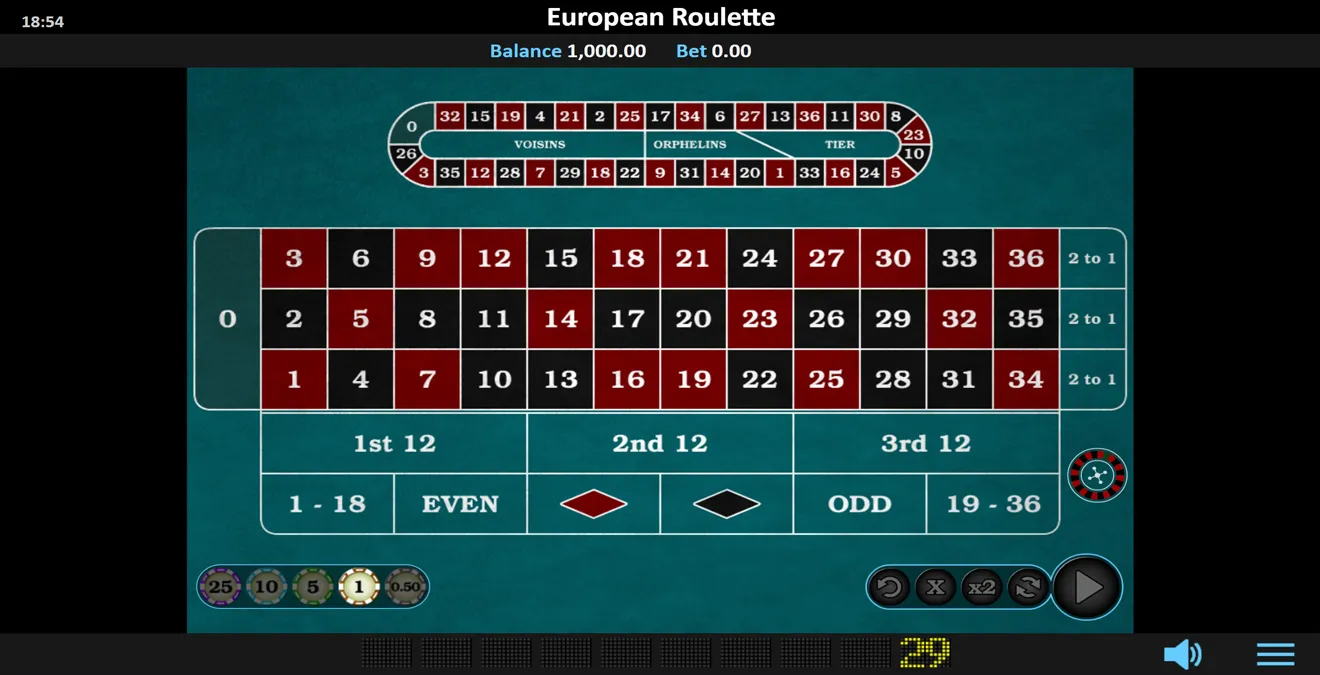
In classic roulette, the wheel has 37 slots (European) or 38 slots (American). Numbers 1-36 alternate between red and black. The green zero (and double zero in American) is what gives the casino its edge. Players bet on individual numbers, groups of numbers, colors, or odd/even - and the ball decides.
European Roulette has a single zero, giving a house edge of 2.70% (RTP 97.30%). It is the most widely played version and the one most people think of when they hear "roulette." Every outside bet (red/black, odd/even) has a near 50/50 chance, and every inside bet (straight-up on a number) pays 35:1.
American Roulette adds a double zero (00), increasing the house edge to 5.26% (RTP 94.74%). The extra slot benefits only the casino. There is no mathematical reason for a player to choose American over European - the double zero simply takes more money over time.
French Roulette uses the same single-zero wheel as European but adds the La Partage rule: if the ball lands on zero, half of any even-money bet is returned to the player. This reduces the effective house edge to 1.35% on outside bets (RTP 98.65%), making it the best classic variant for players.
Here is where it gets important. The "roulette" offered by Gamdom and MetaWin at 100% RTP is not classic roulette. It does not have 36 numbers, no red or black, no inside or outside bets, and no zero slot. It is a completely different game that uses a wheel/spinner visual but operates on an Over/Under mechanic - closer to Dice than to traditional roulette.
In this format, a wheel or strip spins and generates a number from a continuous range. The player bets on whether the result will be above or below a chosen threshold. The multiplier is calculated the same way as in Dice: Multiplier = 100 / Win Probability. There are no betting layouts, no dozens, no columns, and no neighbor bets.
This distinction matters because many players searching for "100% RTP roulette" expect the classic game without a house edge. What they find instead is an entirely different format. Both Gamdom Roulette and MetaWin Roulette Zero are legitimate 100% RTP games - but they are not the roulette you play in a traditional casino.
Classic roulette cannot exist at 100% RTP because the house edge is structural. The zero (and double zero) are built into the wheel itself. Removing them would mean 36 numbers with 36:1 payout - which is exactly 100% RTP but also removes the casino's reason to operate the table.
The Over/Under format solves this differently. By replacing the fixed-number wheel with a continuous range, the game can set multipliers at mathematically fair levels without needing a zero slot. The "roulette" label is more of a branding choice than a mechanical description.
For players who want classic roulette with the best possible odds, French Roulette with La Partage (1.35% edge on even bets) is the answer. For players who want literally zero house edge, the Over/Under versions at Gamdom and MetaWin deliver that - just with a different game format.
Game psychology
The spinning wheel is more than a game mechanic - it is a ritual
No casino game matches the theatrical quality of roulette. The dealer spinning the wheel, the ball bouncing across the slots, the collective intake of breath as it slows down - these moments create something that no digital interface can fully replicate. Roulette is as much about the experience as it is about the bet.
The bet variety adds another dimension. In a single round, one player can bet on a specific number (high risk, 35:1 reward) while another covers red/black (low risk, 1:1). Both watch the same spin with completely different stakes. That flexibility makes roulette the most social casino game - everyone plays together but experiences the result differently.
For the Over/Under zero-edge version, the appeal is different: pure mathematical fairness. Players who value transparency over tradition choose this format because the numbers do not lie. No zero slot, no hidden edge, just clean probability.
Both classic and Over/Under formats are included. Pay attention to the Type column - 100% RTP versions use a different mechanic.
| Game | Provider | RTP | Type | Provably Fair |
|---|---|---|---|---|
| European Roulette | Evolution | 97.30% | Classic (0-36) | No |
| American Roulette | Pragmatic Play | 94.74% | Classic (0-36+00) | No |
| French Roulette | NetEnt | 98.65% | Classic (La Partage) | No |
| Lightning Roulette | Evolution | 97.30% | Classic + multipliers | No |
| Roulette | Stake Original | 97.30% | Classic | Yes |
| Gamdom Roulette | Gamdom Original | 100% | Over/Under wheel | Yes |
| MetaWin Roulette Zero | MetaWin | 100% | Over/Under wheel | Yes |
Math & zero edge
Gamdom and MetaWin offer zero-edge roulette - but the format is different from what most players expect.
In classic European roulette, the house edge comes from the zero slot. There are 37 possible outcomes but straight-up bets pay 35:1 (as if there were only 36). That discrepancy - 1/37 or 2.70% - is the house edge. It applies proportionally to every bet type on the table.
The Over/Under roulette at Gamdom and MetaWin eliminates this by removing the fixed-number structure entirely. Instead of 37 slots with a zero, the game uses a continuous number range where the player bets on whether the result will be above or below a threshold. The multiplier formula is Multiplier = 100 / Win Probability - identical to Dice. No zero, no structural edge.
Gamdom achieves 100% RTP through 99% base math plus rakeback. MetaWin offers Roulette Zero as part of their Zero House Edge Originals with the full 100% built into the game.
This means that when someone says "I play roulette with 100% RTP," they are not playing the game with 36 numbers and a green zero. They are playing an Over/Under prediction game with a roulette-themed visual skin. Both are valid casino experiences, but they should not be confused.
Classic roulette will always have the zero. Zero-edge roulette achieves 100% RTP by being a different game entirely - and that is not a flaw, just a fact.
Critical distinction
Classic roulette and Over/Under roulette are different games
Explore other original formats where operators offer zero-edge or max-RTP configurations.







Bets & systems
No strategy changes the math - but understanding the bets and managing your bankroll makes roulette more enjoyable and sustainable.
Classic roulette has dozens of bet types. The Over/Under version is simpler. Here is how to approach both.
Decide whether you want classic roulette (numbers, colors, traditional bets) or Over/Under zero-edge (threshold prediction, pure math). They are different games that require different approaches.
In classic: choose inside bets (specific numbers, high risk) or outside bets (red/black, odd/even, low risk). In Over/Under: set your threshold and bet direction.
The ball spins and lands. In classic, the landing slot determines all payouts. In Over/Under, the generated number is compared to your threshold.
Winning bets pay according to the payout table. Review your result and adjust your next bet based on your session plan, not on emotion.
Roulette has no memory between spins. The Martingale and other progressive systems do not change the expected value - they only change the distribution of outcomes. Set limits and stick to them.
Understanding the fundamental differences between the two games both called "roulette."
American roulette has nearly double the house edge (5.26% vs 2.70%). There is no strategic reason to play it. If French with La Partage is available, that is even better at 1.35%.
Red/black and odd/even give you almost 50% chance per spin. Straight-up numbers pay 35:1 but hit only 2.7% of the time. Choose based on your session goals, not superstition.
Doubling after every loss looks logical but it requires exponentially growing bets. One bad run hits table limits or destroys your bankroll. The math does not change just because you increase your bet.
If you play the 100% RTP version, treat it like Dice. Set your threshold, understand the multiplier formula, and manage your bankroll accordingly. Do not expect classic roulette gameplay.
Roulette is hypnotic. The spinning wheel, the social atmosphere, the hope of hitting your number. Without pre-set limits, sessions can spiral. Decide your stop-loss and stop-profit before the first spin.
If mathematical fairness is your priority, the Over/Under versions are unmatched. Accept that it is a different format and enjoy it for what it is - the fairest roulette-labeled game available.
Psychology of the game
The wheel is more than a random number generator. It is a ritual.
No other game has the theatrical weight of roulette. The croupier announces bets, the wheel spins, the ball bounces - and for a few seconds, the entire table holds its breath. That shared moment of anticipation is why roulette has survived three centuries.
Conservative players bet red/black. Risk-seekers go straight-up on a number. Everyone watches the same spin, but everyone experiences a different game. That inclusiveness is unique to roulette.
The basic concept takes seconds to understand. But the bet variety, combination strategies, and statistical edge differences between formats give analytical players plenty to work with.

Answers that matter
Key questions about classic roulette, the Over/Under zero-edge format, and how they compare.
100% RTP roulette is an Over/Under number prediction game, not European or American roulette with a spinning wheel. You set a threshold on a continuous number range and bet whether the result lands above or below. The payout scales with probability so expected return equals your wager. Available at Gamdom and MetaWin.
Classic roulette spins a wheel with 37 or 38 numbered pockets including one or two green zeros. Those zeros create the house edge: 2.7% on European, 5.26% on American, 1.35% on French La Partage. Over/Under removes the wheel entirely. There are no pockets, no green zero. You pick a threshold on a number line and the payout adjusts to match fair odds exactly.
The green zero (plus double zero in American) means every outside bet covers fewer outcomes than the payout implies. Red/black covers 18 of 37 numbers but pays 1:1. Dozens cover 12 of 37 but pay 2:1. That gap between true probability and payout is the permanent house edge of 2.7 to 5.26 percent. No betting system can overcome it long-term.
Gamdom and MetaWin both offer roulette at 100% RTP in the Over/Under format. These are separate games from their classic roulette tables. Duel does not currently have a 100% RTP roulette variant. If you see classic European roulette, that always runs at 97.3% RTP regardless of platform.
Yes. Both Gamdom and MetaWin use provably fair cryptographic systems for Over/Under roulette. Each result can be independently verified using the server seed, client seed, and nonce. Classic roulette on these platforms relies on standard RNG certification, which is audited but not individually verifiable by the player.
You can apply any staking plan to Over/Under roulette. Martingale, Fibonacci, and flat betting all function normally. The key difference is that at 100% RTP no strategy has a mathematical disadvantage or advantage. In classic roulette every strategy loses 2.7 to 5.26 cents per euro in the long run because of the zero.
If reducing house edge is your goal, absolutely. Over/Under at 100% RTP returns everything in expected value. Classic roulette offers the iconic table experience with inside bets, outside bets, neighbors, and announced bets like Voisins du Zero. But that experience always costs you 2.7% or more per spin. The choice depends on whether you value tradition or pure math.